UGC vs Influencer Marketing: 6 Differences Every D2C Founder Must Know
With one you rent an audience. With the other you own an asset. Confusing them is the most expensive mistake in Indian D2C marketing.
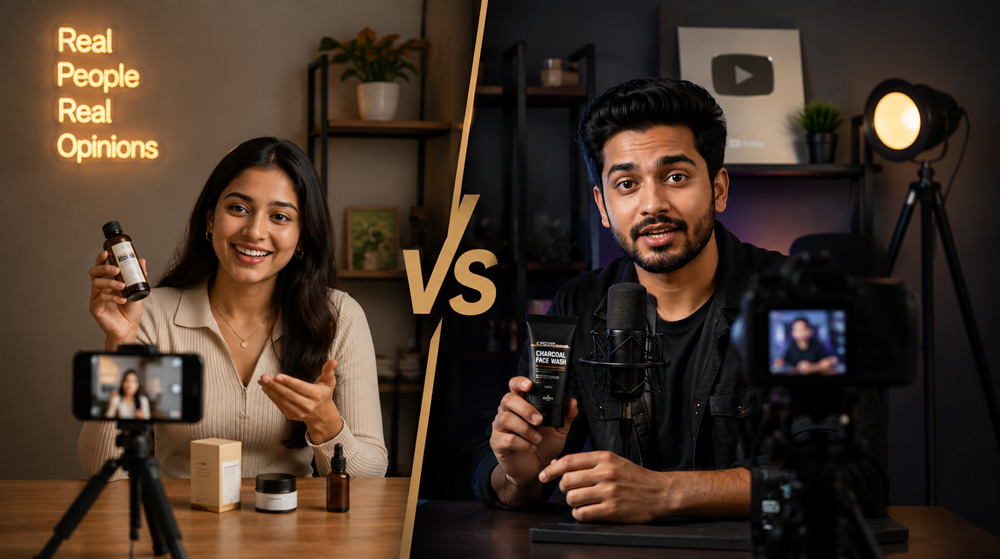
Ask ten Indian D2C founders to define the difference between UGC vs influencer marketing and you will get ten overlapping, mostly wrong answers. The confusion is expensive, because the two disciplines solve different problems, cost different amounts, and fail in different ways.
The core difference, stated once
Influencer marketing buys access to someone else's audience. UGC buys an asset you own and run on your own ad account.
Everything else follows from this. If you internalise nothing else from this article, internalise that sentence.
Six key differences
1. What you are actually purchasing
Influencer marketing: distribution. The creator posts to their followers and you borrow their trust. UGC: footage plus usage rights. The creator films, hands you the file, and you distribute it yourself through paid media.
2. Where the content lives
Influencer content lives on the creator's handle and reaches their audience once. UGC lives in your ad account and reaches whoever you pay to reach, indefinitely.
3. How performance is measured
Influencer campaigns are measured on reach, engagement, and where trackable, promo-code redemption. UGC is measured on hook-through rate, click-through rate, and return on ad spend. The second set of numbers is far more actionable and far less flattering.
4. Creator selection criteria
For influencer marketing, follower count and audience overlap dominate — you are buying reach, so reach matters. For UGC, follower count is almost irrelevant. You are buying performance on camera and category fluency. Some of our highest-performing UGC creators have under 5,000 followers.
5. Cost structure
Influencer fees scale with audience size, and scale steeply. UGC fees scale with production complexity and hook count. A macro influencer post can cost more than an entire ten-video UGC batch.
6. Shelf life
An influencer post has a shelf life of roughly 48 hours before the feed buries it. A UGC creative can run in a paid account for six months, be re-cut with new hooks, re-voiced into three languages, and re-cropped for four placements. This is the single most underappreciated difference.
Side-by-side comparison
| Dimension | UGC | Influencer Marketing |
|---|---|---|
| You buy | Footage + usage rights | Audience access |
| Content lives on | Your ad account | Creator's handle |
| Primary metric | ROAS / CPA | Reach / engagement |
| Creator picked for | Category fluency | Audience size & fit |
| Typical cost | ₹12K–40K per video | ₹25K–5L per post |
| Shelf life | 3–12 months | 24–72 hours |
| Scales via | Ad spend | More creators |
| Best for | Cold traffic conversion | Launches & credibility |
When to choose UGC
- You are spending meaningfully on Meta Ads and creative fatigue is your bottleneck.
- You need volume — ten-plus creatives a month — and cannot afford influencer rates at that cadence.
- Your product benefit is demonstrable on camera.
- You want to own the asset rather than rent the moment.
This is the majority case for scaling D2C brands. Our UGC video production service exists for exactly this.
When to choose influencer marketing
- You are launching and need credibility you have not yet earned.
- You are entering a category where a trusted voice's endorsement carries genuine weight.
- You need reach in a specific community that paid targeting cannot cleanly isolate.
- You are building category authority rather than driving immediate conversion.
Our influencer marketing service handles these campaigns end-to-end.
When to run both
The sophisticated answer is that mature brands do both, and structure the influencer deal to include UGC usage rights. You pay the creator to post to their audience and you retain the footage for paid media. This is standard practice in the US and still rare in India, which means it is currently underpriced. Negotiate for it.
Summary
UGC vs influencer marketing is not a choice between two versions of the same thing. Influencer marketing rents attention for two days. UGC buys an asset that works for a year. Most scaling D2C brands need far more of the second than they currently buy.
See our case studies for both approaches in practice, or book a free strategy call.