11 UGC Video Hooks That Convert: Proven Script Formulas for 2026
Roughly 70% of your ad's performance is decided in the first three seconds. Here are the eleven hook formulas that consistently win those seconds.
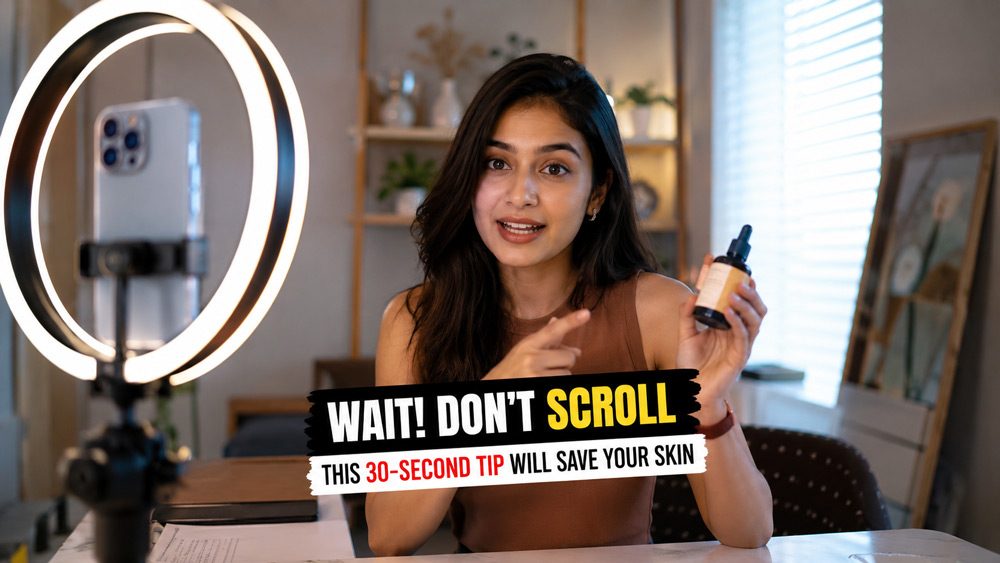
A hook is the first three seconds of your UGC video ads. It is not your logo, not a product beauty shot, and not a music sting. It is the single mechanism by which a scrolling thumb decides to stop. Get it wrong and the remaining twenty-seven seconds of your creative are never seen by anyone.
The three-second rule
In our internal data across several hundred creatives, hook-through rate — the percentage of viewers who watch past three seconds — correlates more strongly with final ROAS than any other single variable, including creator, product, and offer. It is the highest-leverage sentence you will write all quarter.
This is why every creative we ship carries three to five alternate hook openings on identical body footage. Same creator, same demonstration, same CTA. Different first three seconds. The spread in performance between the best and worst hook on the same footage is routinely 4x.
The 11 hook formulas
1. The contrarian claim
"Stop buying [category]. Here is why." Opens by contradicting the viewer's expectation of an ad. Works because ads never begin by telling you not to buy.
2. The mistake reveal
"I was using this completely wrong for two years." Triggers loss aversion. The viewer needs to know if they are making the same mistake.
3. The validated objection
"I did not think a ₹400 serum could work either." Names the viewer's scepticism before they can voice it. Earns the right to spend the next twenty seconds dismantling it.
4. The visual pattern interrupt
No dialogue at all. A texture transforming, a garment moving, a product doing something unexpected in extreme close-up. Our highest hook-through rates come from this category. See the Renée case study.
5. The specific number
"Three weeks. Zero breakouts." Specificity is credibility. "Amazing results" is noise; a number is an argument.
6. The overheard comparison
"My sister asked what I have been using." Social proof delivered obliquely, without the creator claiming anything about themselves.
7. The problem tableau
Open on the frustration, not the product. A drawer that will not close. Foundation sliding at 2pm. The visual of the problem, held for two seconds, before a word is spoken.
8. The credential drop
"As someone with eczema, I do not test things casually." Establishes standing to speak. Only works when the credential is genuine, which is why casting matters.
9. The direct question
"Why is nobody talking about this?" Overused, still effective. Curiosity is a reliable engine. Degrades quickly with repetition, so rotate it out after four weeks.
10. The unboxing tension
Packaging in frame, unopened, hands moving toward it. Delays gratification by two seconds. Works disproportionately well in premium and gifting categories.
11. The mid-action open
The creator is already halfway through something. No introduction, no setup, no "hey guys." Feels like content the viewer scrolled into rather than an ad served to them.
Rules for writing hooks
- Never mention the brand in the hook. The brand name in second one is the fastest way to signal "advertisement" and lose the scroll.
- Write for sound-off. A majority of Meta viewers have audio muted. If the hook only works aurally, it does not work.
- One idea. A hook containing two ideas contains zero.
- Specific beats clever. Cleverness makes copywriters happy. Specificity makes media buyers happy.
- Say it out loud. If a real person would not say the sentence in a real conversation, cut it.
How to test hooks properly
Produce one body of footage. Cut it with five different hook openings. Launch all five into a broad campaign with equal budget allocation and no manual intervention. Read hook-through rate at seven to nine days. Kill the bottom three. Scale the top two, and produce three fresh hook variants against the winning angle.
Do not test hooks against different footage. You will learn nothing about hooks and everything about footage, which was not the question.
What never to do
Do not open on a logo. Do not open on a price. Do not open with "Hey guys." Do not open with a music sting and no visual event. Do not open with a wide shot — vertical video demands frame-filling composition inside the first second, and a wide shot wastes the only three seconds you were given.
Summary
The hook is 70% of the job. Write eleven, test five, scale two, and never mention your brand in the first three seconds. For a working example of hook architecture in a live campaign, read the Snackible case study.
Explore our UGC video ads service or book a free strategy call.