ASCI Influencer Disclosure Checklist for Indian Brands: Labels, Stories and Contracts (2026–2027)
A working ASCI influencer disclosure checklist for brand teams — which labels are allowed, where they go in Reels, Stories, Shorts and live streams, and the contract clauses that stop one missed tag from becoming a public complaint.
An ASCI influencer disclosure checklist is the one document most Indian brand teams skip until a complaint lands in their inbox. The creator forgets the tag, the Story goes up without a label, and suddenly the brand — not just the creator — is answering for a misleading advertisement. If you run creator partnerships across Instagram and YouTube, disclosure is not a legal footnote. It is a production step, like checking the product name is spelled right.
This guide gives you the checklist we use at Adverra Studio before any influencer post is approved: when a post counts as an ad, which labels the Advertising Standards Council of India (ASCI) accepts, where each label goes by format, and what to put in the contract. I am Prince, and I have been running creator content since 2015. None of this is legal advice — it is the operational side, so your team stops losing campaigns to avoidable mistakes.
Key takeaways
- Any material connection — money, free product, trip, discount, affiliate commission — makes a creator post an ad that needs a label.
- ASCI lists specific labels (Advertisement, Ad, Sponsored, Collaboration, Partnership, Employee, Free gift). #sp, #collab-only shorthand and bio disclaimers do not count.
- The label must be upfront: first lines of a caption, superimposed on Stories and pictures, on screen in videos, and spoken at the start and end of audio.
- Platform tools like Instagram’s Paid partnership tag are used in addition to an ASCI label, not instead of it.
- Put disclosure in the brief, the contract and the review step — then screenshot every live post as proof.
What does ASCI actually require from influencer posts?
ASCI requires that any influencer post promoting a brand with which the creator has a material connection carries a clear, upfront disclosure label that an average viewer cannot miss. The label must be visible without clicking “see more”, and the content itself must not mislead — claims need to be true and substantiated.
ASCI is a self-regulatory body, and its Guidelines for Influencer Advertising in Digital Media have applied since 2021. They sit alongside the government’s own endorsement guidance from the Department of Consumer Affairs, which points the same way: if a creator is paid or rewarded, the audience must be told, clearly and in a language they understand. ASCI publishes a plain-language influencer FAQ page and a downloadable guide for influencers. Read both once. Then turn them into a checklist your team actually runs.
Three ideas carry almost all of the weight. Disclosure: tell people it is an ad. Prominence: tell them where they will see it. Honesty: do not let the creator say something the brand cannot prove. Most brand-side problems are not about intent — they come from a Story posted at 11 pm by a creator who never saw the brief’s last page.
Why the brand owns the risk, not just the creator
ASCI processes complaints against the advertiser as well as the influencer. In practice, the brand is the party with the contract, the brief and the approval rights, so it is the brand that is expected to have controls. “The creator forgot” is an explanation, not a defence. That is why an ASCI influencer disclosure checklist belongs with the marketing team, not with whoever handles creator payments.
When does a creator post count as an ad?
A creator post counts as an ad when there is any material connection between the creator and the brand, paid or unpaid. Money, free products, gifted trips, discount codes, affiliate commissions, barter deals and even an employment relationship all count — and the post then needs a label.
Indian D2C brands most often get this wrong with barter and seeding. You send a skincare kit to forty nano creators “with no obligation”, ten of them post, and none of them label it because “nobody paid me”. Under ASCI’s approach, the free product is the connection. The same applies to a fashion brand that gifts a festive outfit, a wellness brand that sends a month of supplements, or a food brand that hosts creators at a launch dinner.
| Situation | Material connection? | Label needed |
|---|---|---|
| Paid Reel or Short with a fee | Yes | Ad / Advertisement / Sponsored |
| Product sent free, creator chooses to post | Yes | Free gift |
| Affiliate link or personal discount code | Yes | Ad or Collaboration (plus the code context) |
| Long-term ambassador or barter deal | Yes | Partnership / Collaboration |
| Employee posting about their own company | Yes | Employee |
| Creator bought the product and posts unprompted, no contact | No | Not required |
Simplified from ASCI’s influencer guidance. If any row is a grey area for you, label it — over-disclosure has never caused a complaint.
The test we give clients is simple: would this post exist, in this form, without the brand’s involvement? If the answer is no, it is an ad. This also covers UGC creators whose content runs on the creator’s own handle, which is why the same rules apply when you boost their post as a partnership ad on Meta.
Which disclosure labels are allowed?
ASCI accepts a defined list of labels: Advertisement, Ad, Sponsored, Collaboration, Partnership, Employee and Free gift. Anything else — #sp, #spon, #collab, “thanks to the brand” or a line in the bio — is not an approved disclosure, and ASCI may add or revise labels over time.
Pick the label that matches the actual deal. A paid post should say Ad, Advertisement or Sponsored. A free-product post should say Free gift. An employee should say Employee. Collaboration and Partnership fit long-running relationships. We ask creators to use the word as a hashtag or plain text at the very start of the caption, for example “#Ad | My 30-day routine with…”. Always check the current list on ASCI’s site before a big launch, because it can be updated.
| Label or practice | Accepted? | Our note |
|---|---|---|
| #Ad, #Advertisement, #Sponsored | Yes | Default for any paid post |
| #Collaboration, #Partnership | Yes | Use for ambassador or barter deals |
| #FreeGift, #Employee | Yes | Seeding kits and staff posts |
| Instagram Paid partnership tag alone | Not enough | Add an ASCI label as well |
| #sp, #spon, #collab, #gifted | No | Shorthand viewers may not understand |
| Disclosure only in the bio or after “more” | No | Blanket and hidden disclosures fail |
| Label buried among 25 hashtags | No | Must be prominent, not lost |
Labels per ASCI’s influencer FAQs at the time of writing. Re-check the official list before each campaign.
Platform tag plus ASCI label. Instagram’s Paid partnership tag, YouTube’s “includes paid promotion” setting and similar tools help, but they are platform features, not ASCI labels. The safe default is both: the platform tool switched on and an ASCI label in the first line or on screen.
Where should the label go in Reels, Stories, Shorts and live?
Place the label where the viewer sees it before or while they see the promotion. For captions that means the first lines above the fold; for Stories and picture posts, superimposed on the image; for video, on screen and readable; for audio, spoken at the beginning and the end; for live streams, at the start and repeated through the broadcast.
Format is where most campaigns slip. A creator labels the feed Reel perfectly, then posts three Stories with a swipe-up link and no label at all. Your ASCI influencer disclosure checklist should therefore list every deliverable separately — Reel, each Story frame, Short, long-form video, live and any cross-post — and tick placement for each one.
| Format | Where the label goes | What we check at review |
|---|---|---|
| Instagram Reel / feed post | First line of caption + on-screen text | Visible without tapping “more”; not inside the 9:16 UI overlap zone |
| Instagram Story (each frame) | Superimposed on the frame | Every frame that shows the product, not only the first |
| YouTube Shorts | On-screen text + title or first description line | Paid promotion setting switched on |
| Long-form YouTube video | On screen during the brand segment + spoken mention | Label present for the whole integration, not just the intro |
| Live stream | Spoken and on screen at start and end, repeated during | Host script has the line written in |
| Podcast / audio clip | Spoken at beginning and end | Clear words, not a fast mumble |
Video timing: how long should the label stay on screen?
ASCI’s guidance for video ties label duration to video length. As we read it, very short videos (around 15 seconds) need the label on screen for a few seconds at least, mid-length videos need it for a meaningful share of the runtime, and long videos need it for the whole section where the brand is promoted. Check the exact durations in ASCI’s current guideline. Our production rule is simpler and stricter: the label stays on screen for the full time the product is on screen. It costs nothing in the edit and removes the argument.
Safe placement inside the 9:16 frame
On Reels and Shorts, the bottom of the frame is covered by the caption, audio line and buttons, and the right edge holds the like and share icons. Put the label in the upper-middle area, high enough to clear the profile row, in a solid text box with strong contrast. Same font size as the creator’s other captions or larger. We brief creators to film with that top band clear, which is far easier than fighting a busy background in post.
The 20-point ASCI influencer disclosure checklist
Run this ASCI influencer disclosure checklist in four stages: before the brief, in the brief and contract, at content review, and after the post goes live. Each stage has five checks, and a post is not approved for payment until all twenty are ticked.
Stage 1 — Before the brief (ASCI influencer disclosure checklist, part one)
- Map the connection. Paid, gifted, affiliate, barter or employee — write it down per creator.
- Choose the label that matches the connection from ASCI’s accepted list.
- List every deliverable separately: Reel, each Story frame, Short, video, live, cross-posts.
- Check claim substantiation. Every efficacy, “clinically proven”, “No. 1” or before/after claim the creator may say needs evidence in your file.
- Flag special categories — health, nutrition, finance, investments — where creator qualifications matter.
Stage 2 — In the brief and contract
- Write the exact label text into the brief, e.g. “#Ad as the first word of the caption”.
- Specify placement per format using the table above.
- Add the disclosure clause to the contract (wording ideas in the next section).
- Supply approved claims only — a short “say this, never say that” list.
- Agree usage rights separately: organic post, partnership ads, brand handle, duration.
Stage 3 — At content review
- Watch the draft on a phone, not a laptop, to judge prominence realistically.
- Check the label is readable and clear of the platform UI zones.
- Check spoken claims against the approved list; no “cured”, “guaranteed” or invented numbers.
- Check filters — beauty filters must not exaggerate the product’s effect.
- Approve the caption with the label in the first line, before hashtags and mentions.
Stage 4 — After the post goes live
- Screenshot every live post and Story with date and time visible on your device.
- Confirm the platform tag (Paid partnership / paid promotion) is switched on.
- Check edits — creators sometimes edit captions later and drop the label.
- Check partnership ads carry the same disclosure as the organic post.
- Release payment only after items 16–19 pass, and file the proof per creator.
That last step is the one that changes behaviour. When payment depends on a correct label, creators stop treating disclosure as optional. At Adverra Studio, we keep the screenshots in the same campaign folder as the brief and invoice, so if anyone ever asks, the evidence is one click away. Boring paperwork is cheaper than a public complaint.
What should the influencer contract say about disclosure?
The influencer contract should name the exact label, its placement for each format, the approved claims, the platform tool to switch on, and what happens if a post goes live without disclosure. It should also separate disclosure from usage rights, because the two are different promises.
You do not need a thirty-page agreement for a nano creator. You do need five or six clear clauses. Get your legal adviser to finalise wording — the list below is what our team asks clients to cover, written in plain language.
- Disclosure clause: “The Creator will use the label [#Ad] as the first word of every caption and as on-screen text on every video and Story frame featuring the product, in line with ASCI’s influencer guidelines.”
- Platform tool clause: the creator switches on the platform’s branded content or paid promotion setting and adds the brand as partner.
- Claims clause: the creator only uses claims from the approved list and does not make medical, financial or comparative claims beyond it.
- Review clause: drafts are shared before posting; the brand may request label fixes without a revision fee.
- Correction clause: if a post goes live without the label, the creator adds it or takes the post down within a set number of hours.
- Payment link: final payment is released after the brand verifies live posts.
Disclosure and usage rights are two separate promises
Disclosure tells viewers the post is an ad. Usage rights decide where the brand may reuse the content — partnership ads on Meta, the brand’s own handle, website, marketplace listings — and for how long. Brands often assume one covers the other. It does not. If you plan to run a creator’s Reel as a partnership ad for 90 days, write that into the contract with the media, territory and duration, and keep the label visible in the ad version too. We cover this in depth in our guide to choosing between micro and macro creators, because rights costs scale very differently between the two.
How do health, finance and virtual influencers change the checklist?
Health, nutrition and finance content carries extra expectations: ASCI added guidance in 2023 asking creators who give health or financial advice to hold relevant qualifications and disclose them. Virtual or AI-generated influencers must also tell viewers clearly that they are not real people.
Wellness, skincare and nutrition brands
If a creator gives health or nutrition advice — “this supplement fixes your gut”, “this cream treats acne” — the bar rises. Under ASCI’s 2023 additions, health influencers giving advice are expected to have appropriate qualifications, such as a registered medical or nutrition background, and to state them prominently. For most beauty and wellness campaigns, the practical fix is to keep creators on experience (“my skin felt less oily after two weeks”) and away from medical advice. Put that line in the brief, in bold.
Finance, fintech and investment products
Finance creators talking about investments are expected to be appropriately registered — for investment advice, that generally means SEBI registration — and to show their registration details. For a fintech app campaign, keep creators on product features and user experience, and route anything that sounds like advice through your compliance team first.
Virtual influencers and AI-generated creators
ASCI’s guidance asks virtual influencers to disclose upfront that viewers are not interacting with a real human being. As AI avatars and AI UGC become common in 2026, treat this as a second label: the post needs the ad disclosure and a clear “virtual creator” or “AI-generated” note. Our comparison of UGC and influencer marketing explains when real people are worth the extra cost; synthetic presenters bring their own disclosure work.
How to run disclosure checks across a 20-creator campaign
Run disclosure as a tracked workflow, not a reminder message. Use one tracker with a row per deliverable, five fixed steps per row, and one owner on the brand side who signs off before payment. Twenty creators and sixty deliverables become manageable when every row has the same checks.
- Build the tracker. Columns: creator, connection type, label, format, draft link, review status, live link, screenshot, payment status.
- Send a one-page disclosure sheet with the brief: label text, placement diagram per format, approved claims, never-say list.
- Review every draft on a phone and log fixes in the tracker, not in WhatsApp threads.
- Verify within 24 hours of going live: label, platform tag, caption order, Story frames.
- Close the row only when proof is filed — then release payment.
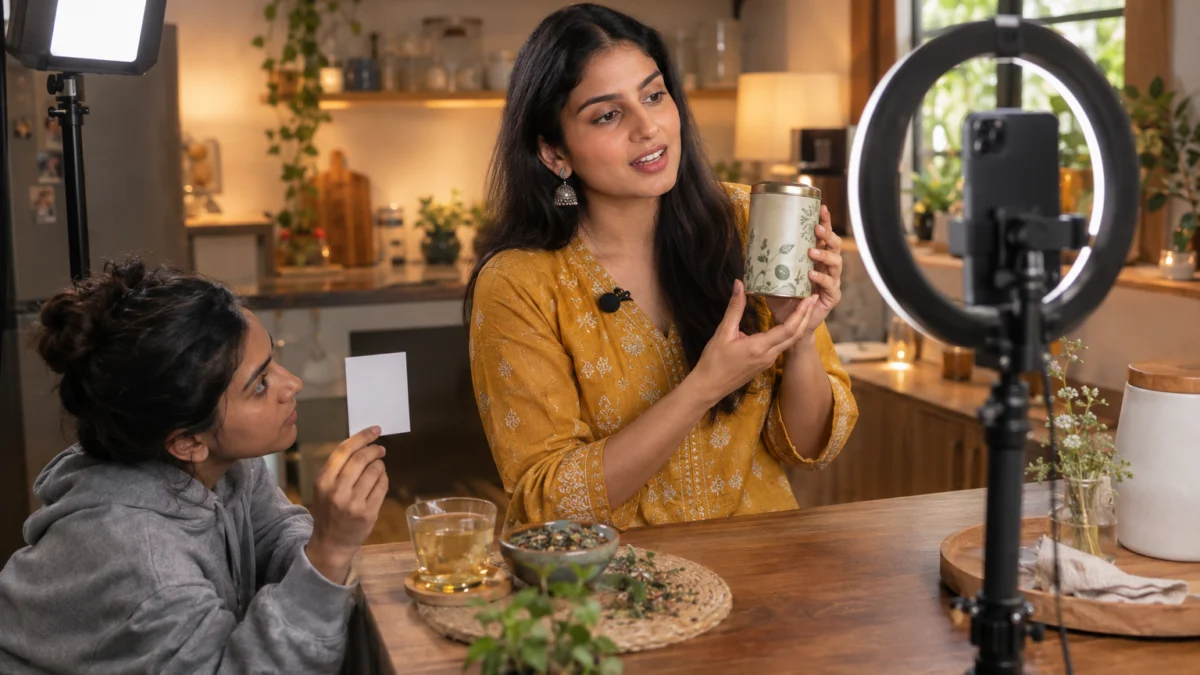
For live streams and long Stories, a physical cue card on set works better than any reminder. Creators improvise, and the disclosure is the first line they drop when they are in flow. When our team produces creator content for brands, the disclosure line is written into the script like any other line, and the editor checks it in the same pass as subtitles. If you want the shoot itself handled — script, creator, filming and edit with the label planned in — that is what our creator-made product videos service covers.

Which disclosure mistakes trigger complaints?
The mistakes that trigger complaints are predictable: unlabelled Stories, labels hidden after “more” or among hashtags, gifted products treated as unpaid, platform tags used without an ASCI label, and claims the brand cannot prove. Fixing these five covers most of the risk.
- Labelling the Reel, forgetting the Stories. Every Story frame with the product needs its own label.
- The 30-hashtag burial. “#skincare #glowup #ad #routine…” — the label is technically there and practically invisible.
- “It was just a gift.” Seeding kits are a material connection; use Free gift.
- Relying only on the Paid partnership tag. Add the ASCI label as well.
- Unproven claims in a creator’s words. If the brand cannot substantiate it, the creator should not say it — label or no label.
- Edited captions. A creator edits the caption a week later to add a giveaway and deletes #Ad. Re-check live posts after a few days.
ASCI also flags that beauty filters which exaggerate a product’s effect can make an ad misleading. For skincare and makeup, brief creators to film product results without face filters. Honest results also convert better when the same content later runs as an ad — viewers trust what looks real.

What is changing in 2026–2027?
Expect more scrutiny of AI-generated creators and synthetic content, more attention to Stories and live commerce, and tighter brand accountability for creator claims. Some reports describe new 2026 ASCI rules on AI content; until you confirm them on ascionline.in, treat AI disclosure as best practice rather than settled detail.
Three shifts matter for planning. First, AI presenters and AI UGC are now common in Indian ad accounts, and regulators everywhere are moving towards “tell the viewer it is synthetic”. Second, live shopping and long Story sequences are growing, and those are exactly the formats where labels get dropped. Third, partnership ads mean one creator post can reach millions through paid distribution, so a missing label is multiplied by your ad budget.
The practical response is the same as always: update your ASCI influencer disclosure checklist once a quarter against ASCI’s official pages and the Department of Consumer Affairs’ guidance on the Department of Consumer Affairs website, and brief creators on any change before the next campaign. If you ever need help, call or WhatsApp +91 90153 33841.
ASCI influencer disclosure checklist: FAQs
Short answers to the questions brand teams ask us most often about influencer disclosure in India.
No. ASCI treats platform tools as helpful but separate. The safe practice is to switch on Instagram’s Paid partnership tag and also add an ASCI-accepted label such as #Ad or #Sponsored in the first line of the caption and on screen in the video, so viewers see it immediately.
Yes. A free product is a material connection under ASCI’s influencer guidance, even if the creator was not paid and was not required to post. Use the Free gift label at the start of the caption and on screen, and include seeding creators in your disclosure tracker like any paid creator.
Superimpose the label on every Story frame that shows or mentions the product, not only the first frame. Keep it in the upper-middle area, clear of the profile row and reply bar, in a solid text box with strong contrast so it is readable on a phone at normal viewing speed.
ASCI can process a complaint against both the advertiser and the influencer. Because the brand controls the brief, contract and approval, it is expected to have checks in place. A contract clause, draft review, live-post screenshots and payment linked to compliance are the simplest ways for a brand to show it took reasonable steps.
Yes. ASCI’s guidance asks virtual influencers to tell viewers upfront that they are not interacting with a real person, in addition to the normal ad label. For AI-generated presenters or AI UGC, add a clear “virtual creator” or “AI-generated” note on screen and in the caption, and check ASCI’s site for newer rules.
Yes. When a brand boosts a creator’s post as a partnership ad on Meta, the content is still a creator endorsement and should carry the same ASCI label as the organic post. Check that the ad version keeps the on-screen label and caption disclosure, and that your contract covers paid usage, media and duration.
Next step: once disclosure is part of your workflow, the bigger win is turning compliant creator posts into ads that scale. Our team edits approved creator content into performance UGC creatives for Meta with the label kept in every cut and multiple hook variants for testing. Email [email protected] or call +91 90153 33841 to plan your next campaign.
Five steps to disclosure-proof creator campaigns
The same sequence our team runs for every influencer deliverable, from brief to payment.
Map the connection
Record whether each creator is paid, gifted, affiliate, barter or employee, and pick the matching ASCI label.
Brief the label
Write the exact label text, placement per format and approved claims into a one-page disclosure sheet.
Review on a phone
Check every draft on a phone for readable labels clear of the 9:16 interface zones and for unproven claims.
Verify live posts
Within 24 hours, screenshot every post and Story frame and confirm the platform partnership tag is on.
Release payment
Close the tracker row and pay only when proof is filed, then re-check captions a few days later.
Creator campaigns with disclosure built in
Share your products, platforms and timelines. Our team plans creators, briefs, labels and usage rights together. Free Meta Ads audit worth ₹5,000 on request.